
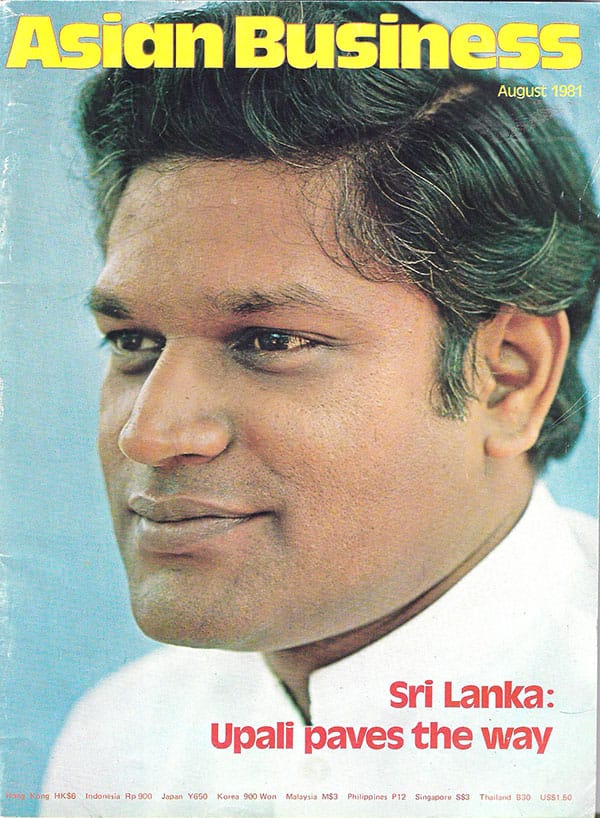
Four decades and more on, the spectacle of Sri Lanka’s first home-grown business magnate of international repute- Upali Wijewardene’s life and mysterious disappearance just four days short of his 45th birthday, still holds us in its grip.
Perhaps some Upali Wijewardene enthusiasts would be intrigued to see how the then 45-year-old Upali would look today, 43 years later, at 88, They will resort to AI, a banality today. AI enthusiasts would even a go a step beyond and recreate his mysterious disappearance when he vanished without a trace in his Lear jet with five others on board when returning home from Malaysia on a day like this 43 years ago.
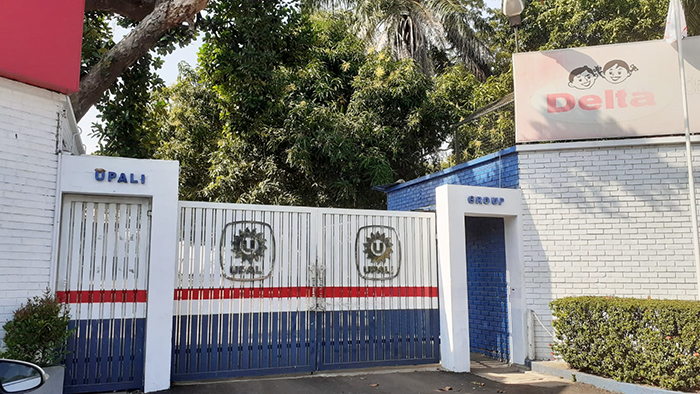
Upali Group Head office- Bloemendhal Road
Upali Wijewardene, who was dubbed the ‘Quintessential Entrepreneur of Asia’ and ‘the man who would be President’ plunged into chocolate-making, assembly of cars, newspaper publishing, aviation, plantations and so much more in a technologically austere time, long before the AI revolution.
With his innovation and innate skill, from a small confectionary manufacturer, Upali expanded his company to one of Asia’s largest and most diverse manufacturing concerns. And he achieved all of it and showed the world what the Sri Lankan entrepreneurship was capable of, in an era where global connectivity was minimal. Matt Miller (Insight, May 1981) once described Upali as ‘Sri Lanka’s most free-wheeling industrialist’ and ‘commodities wizard’.
Upali Wijewardene who holds the record of being the only home-grown Sri Lankan entrepreneur owning a multi-national to have been featured in the prestigious Fortune magazine so far, advocated: ‘plunge in and get on with it’ and was never stifled by the past benchmarks. As was once documented, ‘the success story of Upali, is the story of how small Asian companies can grow into multinational corporations. It was a precursor of the coming of age of the ‘entrepreneurial Asian.’
A man of uncommon enterprise, Upali built a global corporation which spanned several countries including Malaysia, Singapore and the USA in the 1970s and the early 80s in an era of snail mail, telegrams and pre-booked international calls when international communication took weeks and travel overseas was expensive and a luxury. The great strides he took and speed at which Upali operated despite the hurdles in a technologically-Spartan era is astounding.
Upali’s focus on branding was unmatched. The concept of Free Trade Zones which was his brainchild, not only created a fresh economic future for Sri Lanka but was upheld as innovative by other regional counterparts who came forward to replicate them. Upali shaped new paths and futures and created an impact in the minds and hearts of Lankans whom he inspired to ‘dream big.’ He hammered home the message that we didn’t necessarily have to be conservative in what we wished to attain.
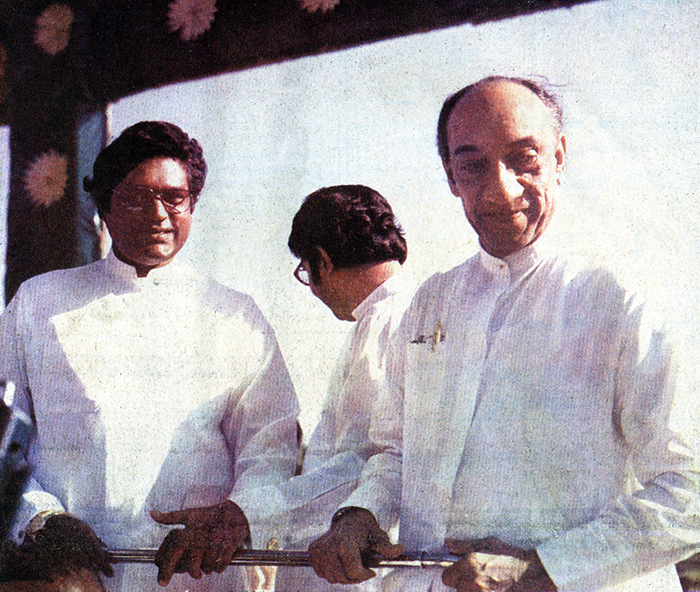
Upali as the Director General of the GCEC on an inspection tour of the Katunayake Free Trade Zone with President Jayewardene (Pic by Prasanna Hennayake)
On a personal note, although I was merely a child at the time of Upali Wijewardene’s untimely demise, I was fortunate to have become a part of the legacy he left behind for Sri Lankan journalism. While Kandos chocolates, Delta toffees, his landmark home in Colombo and the resplendent Nuwara Eliya bungalow and its garden- (which often clinched the ‘Best Garden’ award during the April season) and his Lear jet were motifs I often associated with him as a young child, becoming part of his beloved flagship- Sunday Island, allowed me a vantage point to this towering personality. I would cherish the anecdotes about this trendsetter shared by some of my senior colleagues at Upali Newspapers.
What happened to Upali Wijewardene who captured the imagination of an entire nation, is yet unanswered.Hisdisappearance engulfed the the world with shock and disbelief. US Orion surveillance aircraft, Soviet and Australian warships, Indonesian minesweepers, Indian airplanes, Malaysian patrol boats and Sri Lankan fishermen were all mobilized in search operations to no avail. ‘What if Upali lived? What really happened to Upali?’ continue to be yet unanswered questions.
If Upali Wijewardene was a sensation in life, he was elevated to a legend after he went missing just four days short of his 45th birthday. He caught the imagination of an entire nation. ‘Finding Upali’s plane’ was a game Colombo children of the 80s devised. Many years later, my own brother would confess that while a kid in the Royal Primary, he would sometimes gaze at the sky wishing Upali’s helicopter to land on the helipad of his palatial residence right across Royal College, several years after his disappearance!
“Miss Upali mahathayata mokada une? Eththada thaama innawa kiyanne?’ were often asked by most cab and tuk-tuk drivers each time I hopped onto one at the gates of Upali Newspapers on Bloemendhal road. Wild theories about the disappearance of this maverick still continue to float around.
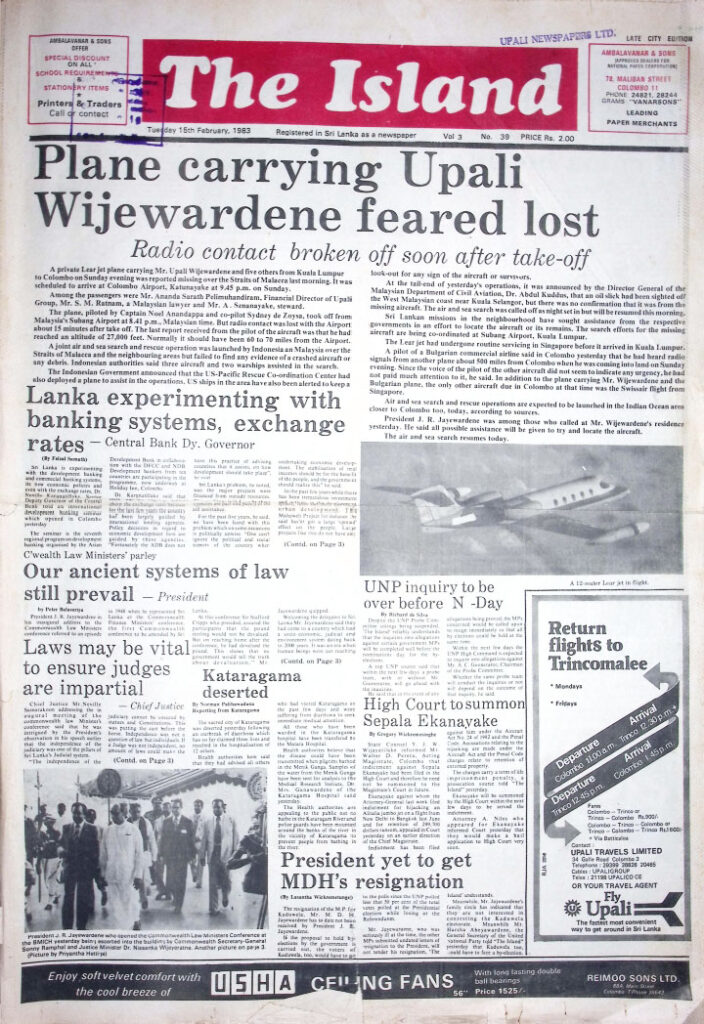
The veteran journalist Ajith Samaranayake once wrote: ‘Upali Wijewardene fascinated people in life and now that he is no longer to be found, lost somewhere in the vast ethereal emptiness, he has become a legend and a cult which continues to enthrall the people…Like Icarus who flew but went too close to the sun so that his wings melted, the strange and fascinating destiny of Upali Wijewardene, Sri Lanka’s first tycoon who also chose the sun as his symbol, will always be a glorious legend of our times…’